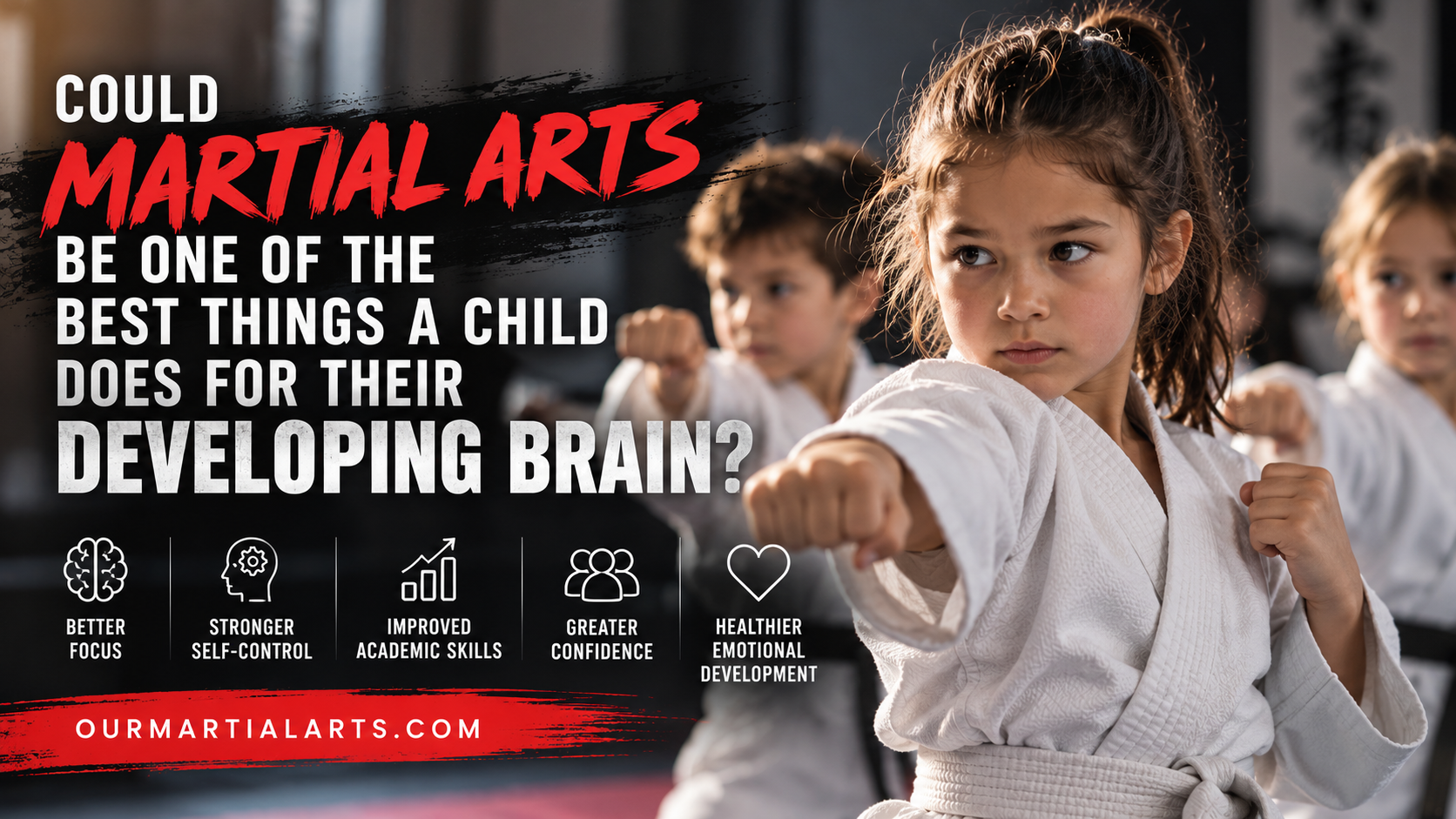
Could Martial Arts Be One of the Best Things a Child Does for Their Developing Brain?
October 15, 2026
Could Martial Arts Be One of the Best Things a Child Does for Their Developing Brain?
**Researchers studying children who practised taekwondo found improvements in attention, self-regulation, and classroom behaviour. Here's what the science actually says about martial arts and child development.**
What if one of the most valuable things a child could learn after school wasn't another academic subject, another hour of tutoring, or another educational app?
What if it was learning how to stand still, listen carefully, control an impulse, respect an opponent, and keep trying after getting something wrong?
These are skills that martial arts instructors have emphasized for generations. But researchers have also begun investigating whether structured martial arts training can help children develop some of the very abilities parents and educators want to encourage.
The findings are fascinating.
Studies have linked martial arts training with improvements in attention and self-regulation, while broader research suggests potential benefits for psychological wellbeing. The evidence isn't identical across every martial art or every child, but there are some compelling findings worth understanding.
And they go well beyond learning how to throw a punch or execute a kick.
## 1. A Study of 240 Children Found Improvements in Attention and Self-Control
Let's start with one of the most interesting studies.
In research published in the journal *Developmental Psychology* in 2022, researchers investigated whether taekwondo could improve children's self-regulation.
The randomized controlled trial involved **240 children aged 7 to 11** at a primary school in the United Kingdom.
The researchers introduced an 11-week beginner taekwondo program and compared its results with those of traditional physical education classes.
The children participated in two 45-minute sessions per week.
After the program, researchers found that children in the taekwondo group were rated by their teachers as having:
- Better attentional control.
- Fewer symptoms of conduct problems.
- Improved performance on a computer-based task measuring executive attention.
Not every measure improved. Researchers did not find significant benefits across all the other measures of self-regulation they examined, including several assessments of inhibition and working memory.
Nevertheless, the results provide evidence that a structured martial arts program can help develop particular aspects of attention and behaviour.
**Why does this matter?**
Self-regulation is the ability to manage attention, emotions, and behaviour in pursuit of a goal.
For a child, that might mean listening to instructions rather than interrupting, staying focused on a difficult assignment, or managing frustration when something doesn't go their way.
These abilities are important throughout childhood, at school, at home, and in relationships with other people.
Martial arts training isn't a substitute for educational or clinical support when a child needs it. But this study suggests that a well-designed martial arts program can be a useful way to practise some of these skills.
[Read the original research in *Developmental Psychology*.](https://pubmed.ncbi.nlm.nih.gov/34941300/)
## 2. An Earlier Study Found Improvements in Classroom Conduct and Mental Maths Performance
The findings weren't entirely new.
In 2004, researchers Kimberley Lakes and William Hoyt published a study examining the effects of school-based taekwondo training on children's self-regulation.
Their research involved **207 children from kindergarten through Grade 5**. Children were assigned by classroom to either a martial arts program or a comparison group receiving traditional physical education.
After three months, the researchers found greater improvements in the martial arts group in several areas:
- Cognitive self-regulation.
- Emotional self-regulation.
- Prosocial behaviour.
- Classroom conduct.
- Performance on a mental maths test.
Yes, a mental maths test.
The researchers weren't suggesting that taekwondo magically teaches mathematics. Rather, their findings raised an interesting possibility: the skills practised during martial arts training may support abilities that are useful outside the dojo.
Think about what happens during a typical class.
A child has to remember a sequence of movements, pay attention to an instructor, coordinate their body, recognize mistakes, and try again. They may need to wait their turn, follow rules, and work with a partner.
These activities require attention, memory, coordination, and behavioural control.
It is plausible that practising these skills repeatedly could help children develop abilities that are useful in other settings. The study provides encouraging evidence, although it does not prove that martial arts training will improve every child's academic performance.
[Read the study in the *Journal of Applied Developmental Psychology*.](https://doi.org/10.1016/j.appdev.2004.04.002)
## 3. Martial Arts May Help Children Learn to Manage Their Emotions
Every parent has seen it happen.
A child loses a game, struggles with a task, gets frustrated with a sibling, or hears something they don't want to hear.
The challenge isn't simply understanding what they should do. It's learning to manage the emotions that make doing the right thing difficult.
Martial arts can create regular opportunities to practise this.
A student might fail to execute a technique, lose a sparring round, struggle to remember a pattern, or discover that another student has progressed faster.
In a constructive training environment, the instructor helps the child respond to these moments appropriately.
They learn to pause, listen, accept feedback, and try again.
Over time, these experiences can provide opportunities to practise patience and emotional regulation.
A 2020 systematic review and meta-analysis examined 14 studies on martial arts training and mental health outcomes. It found a small positive overall effect on psychological wellbeing and a moderate effect on internalizing mental health symptoms, such as anxiety and depression-related symptoms.
However, the studies varied considerably, and the authors found no statistically significant overall reduction in aggression.
This is an important distinction. Martial arts may support aspects of psychological wellbeing, but it would be inaccurate to claim that training automatically makes children calmer or eliminates behavioural difficulties.
The quality of instruction, the environment, and the individual child all matter.
[Read the systematic review and meta-analysis.](https://pubmed.ncbi.nlm.nih.gov/33218541/)
## 4. Confidence Comes From Doing Difficult Things
Confidence is often discussed as though it is something adults can simply give a child through praise.
Encouragement matters, but genuine confidence can also develop when children discover that they are capable of doing something they once found difficult.
Martial arts provides a structured setting for that experience.
A beginner may struggle with basic coordination. A few months later, they may execute a technique correctly, complete a challenging drill, or earn recognition for consistent effort.
Progress is visible. Skills are practised repeatedly, and students have opportunities to recognize how far they have come.
For a child who feels uncomfortable in unfamiliar situations, learning a new skill in a supportive environment can be a meaningful experience.
Importantly, confidence doesn't have to come from winning competitions or being the strongest student in the room.
It can come from showing up when training is difficult, asking for help, accepting constructive feedback, and discovering that mistakes are part of learning.
Parents should also remember that children develop at different rates. A good martial arts school recognizes effort and progress rather than making every student feel they must compete with everyone else.
## 5. Respect and Discipline Become Things Children Practise
Respect is easy to talk about. Learning how to demonstrate it consistently is another matter.
Martial arts schools often build routines around listening to instructors, following safety rules, respecting training partners, and treating others appropriately.
Students learn that their behaviour affects the people around them.
For example, practising a technique with a partner requires cooperation. Both students must follow instructions and respect each other's safety. During sparring, students need to control their movements and follow the rules of the activity.
These experiences can create opportunities to practise responsibility and consideration for others.
The key word is *practise*.
A child won't necessarily become respectful simply because they wear a uniform or bow before entering a training area. The values promoted by a martial arts school depend heavily on how instructors model and reinforce them.
The strongest programs don't just demand respect from students. They demonstrate it, explain it, and apply their expectations consistently.
## 6. Martial Arts Gives Children a Reason to Move
The psychological benefits are only one part of the picture.
Martial arts is also physical activity, and children need regular opportunities to move, develop coordination, and build physical competence.
Depending on the discipline and the class, training can involve:
- Balance and body awareness.
- Agility and coordination.
- Strength and muscular endurance.
- Cardiovascular fitness.
- Flexibility and mobility.
- Reaction time and movement control.
Different martial arts place different demands on the body. A recreational karate class, a judo session, and a competitive boxing program won't provide identical training.
However, a well-designed class can give children an engaging way to develop physical skills while learning something new.
There is also an important practical advantage: children who enjoy an activity may be more willing to participate consistently.
For parents trying to find an alternative to spending every evening in front of a screen, a martial arts class can provide scheduled movement, instruction, and interaction with other children.
It doesn't mean screens are inherently bad or that martial arts must replace every other activity. It simply gives children another opportunity to develop their bodies and abilities.
## 7. Belonging to a Team Can Matter, Even in an Individual Sport
Many martial arts are built around individual progression. Students work toward their own goals, earn grades or belts, and develop skills at their own pace.
Yet training rarely happens in isolation.
Children learn alongside classmates, practise with partners, observe more experienced students, and receive guidance from instructors.
For a child who struggles to find their place in a conventional team sport, a martial arts school may offer a different kind of community.
There can be less emphasis on winning a team selection or scoring goals and more emphasis on personal development.
That doesn't mean every child will feel comfortable immediately. Some may find the environment intimidating at first, and not every school offers the same degree of support.
A welcoming instructor can make a substantial difference by helping beginners feel included, setting realistic expectations, and preventing more experienced students from dominating the class.
When children feel that they belong, they have more opportunities to develop relationships, practise cooperation, and learn from people outside their immediate family.
## 8. Learning to Lose, Fail, and Try Again
One of the most valuable lessons a child can learn is that failure doesn't have to be the end of the story.
In martial arts, progress is rarely perfectly linear.
A technique that felt easy last week may be difficult today. A student might struggle with a grading requirement, lose a match, or need several attempts to understand a movement.
These moments can be frustrating, but they also create opportunities to learn persistence.
With appropriate instruction, children can begin to understand that improvement often requires patience, effort, and feedback.
They learn that a mistake is information, not necessarily a judgment of their ability.
This lesson can be useful well beyond martial arts, including schoolwork, music, friendships, and other activities that require sustained effort.
The aim isn't to teach children that they must tolerate every hardship or never ask for help. It is to help them recognize that challenges can be approached constructively and that seeking guidance is part of learning.
## 9. Does Martial Arts Make Children Less Aggressive?
This is one of the most common questions parents ask, and it deserves a careful answer.
The concern is understandable. Martial arts teaches striking, grappling, and other combat skills. Parents want to know whether learning these techniques will encourage children to fight.
Research does not support a simple answer that applies to every martial art, instructor, and child.
Some studies have reported improvements in behavioural outcomes, while others have found no clear overall effect on aggression.
A 2020 systematic review and meta-analysis found that martial arts training had a minimal, statistically non-significant overall effect on aggression. A separate 2017 meta-analysis of studies involving children and young people found promising results in intervention and longitudinal studies, although the evidence depended on the study design.
The differences highlight why it is important to look beyond the name of the activity.
**The way martial arts is taught matters.**
A school that emphasizes controlled technique, safety, self-discipline, respect, and avoiding unnecessary conflict offers a different learning environment from one that glorifies intimidation or encourages students to prove their toughness.
Parents should look for instructors who set clear behavioural expectations, supervise contact carefully, and teach children that martial arts skills come with responsibility.
Martial arts should never be presented as a guaranteed solution to bullying or behavioural problems. Children who experience bullying may also need support from parents, schools, and other appropriate professionals.
The goal is to help children develop skills and judgment, not to suggest that they are responsible for solving every conflict themselves.
## 10. The Instructor May Matter as Much as the Martial Art
It is tempting to ask which martial art is best for children.
Taekwondo? Karate? Judo? Brazilian jiu-jitsu? Wrestling?
But research into particular programs cannot automatically be generalized to every discipline or school. Much of the promising evidence discussed here comes from specific taekwondo interventions, and broader studies report mixed findings across different settings.
For parents, this makes the training environment especially important.
Look for a school where instructors:
- Teach age-appropriate techniques and expectations.
- Make safety a priority.
- Encourage effort without humiliating students.
- Provide constructive feedback.
- Set clear boundaries around contact and behaviour.
- Treat beginners with patience.
- Teach respect through their own conduct.
- Recognize that children develop at different rates.
Ask whether children are expected to spar, how contact is supervised, and how instructors respond when a student becomes upset or behaves inappropriately.
Watch a class if possible.
A good school should help children feel challenged without making them feel unsafe or unwelcome.
Martial arts is not automatically beneficial in every environment. The instructor's approach, the program's structure, and the child's own needs all influence the experience.
## What Does the Research Really Tell Us?
The science is promising, particularly around self-regulation and aspects of psychological wellbeing. But it is important to distinguish what researchers have demonstrated from what we might reasonably hope martial arts can offer.
Here are some of the key findings.
| Research | Participants | Main findings |
|---|---|---|
| Lakes & Hoyt, 2004 | 207 children, kindergarten to Grade 5 | Greater improvements in several measures of self-regulation, classroom conduct, prosocial behaviour, and mental maths performance compared with traditional PE |
| Ng-Knight et al., 2022 | 240 children aged 7–11 | Better teacher-rated attentional control, fewer conduct-problem symptoms, and improved performance on an executive-attention task |
| Moore et al., 2020 | Systematic review and meta-analysis of 14 studies | Small positive overall effect on wellbeing and a moderate effect on internalizing mental health symptoms; no significant overall effect on aggression |
These studies have different designs, measures, and limitations. They don't establish that every child will experience these outcomes, nor do they show that martial arts is superior to every other organized physical activity.
What they do show is that martial arts deserves to be taken seriously as more than a way to learn fighting techniques.
Structured training can provide children with opportunities to practise attention, persistence, physical coordination, self-regulation, and cooperation. Researchers have found measurable improvements in some of these areas under particular conditions.
More research is needed to understand which programs work best, for which children, and how long any benefits last.
## The Real Value of Martial Arts May Be What Children Carry Outside the Dojo
A belt is visible. A trophy is visible. A successful competition is visible.
But some of the most meaningful changes in a child's development may be harder to measure.
It might be the child who becomes more willing to try something unfamiliar. The student who learns to accept correction without giving up. The beginner who discovers a welcoming community. Or the young person who begins to understand that strength comes with responsibility.
These outcomes are not guaranteed by martial arts training, and they aren't exclusive to martial arts. Other well-run sports, arts programs, and structured activities can help children develop many of the same qualities.
What makes martial arts distinctive is the combination of physical movement, repeated practice, technical learning, clear expectations, and opportunities to work with others.
For families who find a school that teaches these things well, training can become much more than an extracurricular activity.
It can be a place where children learn about their abilities, discover how to respond to challenges, and build skills they can continue developing for years.
And perhaps that is the most important reason to look beyond the punches, kicks, throws, and belts.
**The real measure of a martial arts program isn't only what a child learns to do on the mats. It's what they learn about themselves along the way.**
---
## Research and further reading
1. Lakes, K. D., & Hoyt, W. T. (2004). *Promoting self-regulation through school-based martial arts training.* Journal of Applied Developmental Psychology, 25(3), 283–302. [Read the research](https://doi.org/10.1016/j.appdev.2004.04.002).
2. Ng-Knight, T., et al. (2022). *Does Taekwondo improve children's self-regulation? If so, how? A randomized field experiment.* Developmental Psychology, 58(3), 522–534. [Read the research abstract](https://pubmed.ncbi.nlm.nih.gov/34941300/).
3. Moore, B., et al. (2020). *The effect of martial arts training on mental health outcomes: A systematic review and meta-analysis.* Journal of Bodywork and Movement Therapies, 24(4), 402–412. [Read the research abstract](https://pubmed.ncbi.nlm.nih.gov/33218541/).
4. *Reducing aggression with martial arts: A meta-analysis of child and youth studies* (2017). [Read the research](https://www.sciencedirect.com/science/article/abs/pii/S1359178917300976).
*OurMartialArts.com explores the people, practices, research, and traditions behind martial arts.*