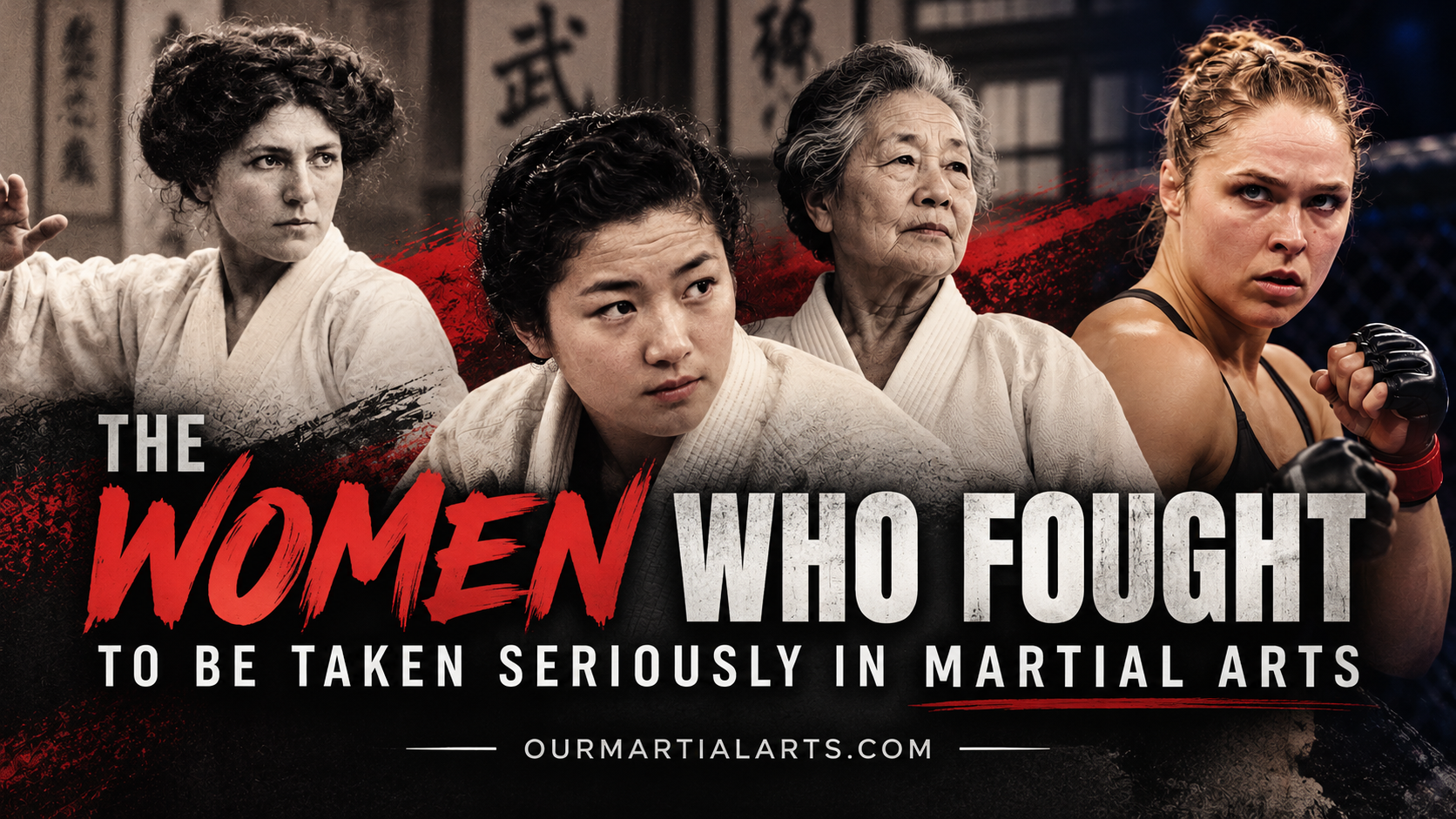
The Women Who Fought to Be Taken Seriously in Martial Arts
October 9, 2026
Long before women headlined major MMA events or stood on Olympic podiums, others were fighting for something more fundamental: the right to compete, train, and be recognized.
In 1959, a judoka named Rusty Kanokogi stepped onto the mat at a tournament in Utica, New York. She competed, won her match, and helped her team win.
Then the organizers discovered she was a woman.
They took away her medal.
Kanokogi's story is one of many that reveal a side of martial arts history that doesn't always get the attention it deserves. Women weren't simply learning to fight. In many cases, they were challenging the rules, traditions, and assumptions that determined whether they were allowed to participate at all.
Some fought in competitions. Others taught, opened schools, and created opportunities for the women who came after them.
Their stories helped shape the martial arts we know today.
Edith Garrud: The Martial Artist Who Trained the Suffragettes
In early twentieth-century Britain, the fight for women's voting rights extended well beyond speeches and demonstrations.
Edith Garrud, a jujutsu instructor, became part of that struggle.
After learning jujutsu from Japanese instructor Sadakazu Uyenishi, Garrud opened her own dojo in London in 1909. She also ran a self-defence club for suffragettes, training women to protect themselves in an era when political demonstrations could turn confrontational.
Her students learned techniques designed to help them defend themselves against physically stronger opponents. Around thirty women trained with her, according to the International Judo Federation.
These weren't simply recreational martial arts classes. Garrud's work connected physical self-defence with a broader struggle over women's independence and their place in public life.
At a time when women were fighting for the right to vote, learning how to defend themselves carried a significance that went beyond the training mat.
Garrud helped demonstrate that martial arts could offer women practical skills, confidence, and a greater degree of control over their own safety.
Rusty Kanokogi: The Woman Who Refused to Accept Second Place
Few stories capture the barriers facing women in martial arts as clearly as that of Rena "Rusty" Kanokogi.
Born in Brooklyn in 1935, Kanokogi discovered judo as a young woman and quickly developed a passion for the sport. She wanted to compete, but women were routinely excluded from tournaments.
In 1959, she found an opportunity to enter the YMCA Judo Championship in Utica, New York. The registration form didn't ask competitors to identify their gender, so she entered the tournament and competed.
She won her match.
When officials learned she was a woman, however, they took away her medal.
Imagine training, preparing, stepping onto the mat, and proving yourself in competition, only to have your achievement dismissed because of who you are.
Kanokogi continued training and teaching. She travelled to Japan to improve her skills and later became one of the most influential advocates for women's competitive judo.
Her work went far beyond her own career. In 1980, she organized the first Women's World Judo Championships at Madison Square Garden in New York. According to the International Judo Federation, she helped finance the event by taking out a mortgage on her home.
She also played an important role in bringing women's judo to the Olympic Games. Women's judo appeared as a demonstration sport at the 1988 Seoul Olympics before becoming a full Olympic medal sport in Barcelona in 1992.
The woman who had been stripped of a medal decades earlier had helped create opportunities for women to compete on the world's biggest sporting stage.
Kanokogi became known as the "mother of women's judo." Her legacy is a reminder that changing a sport sometimes requires fighting outside the competition itself.
Keiko Fukuda: A Lifetime Dedicated to Judo
Keiko Fukuda took a different path, but her impact was just as significant.
Born in Japan in 1913, Fukuda studied under Jigoro Kano, the founder of judo. At the time, opportunities for women to advance in the discipline were limited, and competitive participation was restricted.
Rather than abandoning the art, Fukuda dedicated her life to it.
She became a respected instructor and travelled internationally to teach judo, helping spread its techniques and philosophy to practitioners around the world. Her work contributed to the development of women's judo in the United States, Canada, Europe, and elsewhere.
Fukuda continued teaching for decades. In 2011, she received the rank of tenth dan from the United States Judo Federation, one of the highest distinctions in the discipline.
Her story is not simply about earning a prestigious rank. It is about the decades of work required to build a lasting place for women within a traditional martial art.
Fukuda helped ensure that judo would be passed on to future generations of women not as an exception to the rule, but as an established part of the discipline.
Ronda Rousey and a New Era for Women's MMA
Fast-forward to February 23, 2013.
At UFC 157 in Anaheim, California, Ronda Rousey faced Liz Carmouche in the first women's bout in UFC history.
Rousey had already established herself as a formidable judoka, winning an Olympic bronze medal at the 2008 Beijing Games. She subsequently built a professional MMA career around her grappling and signature armbar submission.
Carmouche, a skilled fighter in her own right, provided a serious challenge. During the bout, she threatened Rousey with a rear-naked choke before Rousey recovered and eventually secured an armbar victory.
The event marked a turning point for women's visibility in the UFC.
Rousey became a major star, but it is important to recognize that women's MMA did not begin with her. Women had competed in mixed martial arts for years, and fighters such as Carmouche were equally part of the moment that brought women's competition into the UFC.
What changed was the scale of the platform.
For the first time, women competed in the Octagon under the UFC banner, in a headline bout that drew significant mainstream attention. The event helped establish women's MMA as an integral part of the promotion.
The journey from Kanokogi's denied medal to a major UFC event was not a straight line. But both stories illustrate the importance of giving athletes the opportunity to prove themselves.
The History of Women's Martial Arts Is Bigger Than a Few Famous Names
These women represent different generations and disciplines, but their stories share a common thread.
They helped expand what was possible.
Some challenged restrictions on competition. Others taught students, established training opportunities, or helped bring women's participation to a global audience.
Their experiences also remind us that progress rarely happens all at once. Opportunities that seem normal today were not always available, and the acceptance of women in martial arts developed differently across countries, styles, and sporting organizations.
There are countless other women whose contributions deserve recognition: the instructors who built local clubs, the competitors who represented their countries, and the practitioners who continued training when they were among the few women in the room.
Not every pioneer became famous. Many made their impact through years of teaching and quiet dedication to their art.
Their contributions matter just as much.
The Legacy Continues on the Mats
Today, women compete at the highest levels of judo, karate, taekwondo, Brazilian jiu-jitsu, boxing, and mixed martial arts. They teach classes, run schools, coach athletes, and introduce new generations to martial arts.
That progress was built by people who came before them.
Edith Garrud used jujutsu to help women defend themselves. Rusty Kanokogi challenged a system that denied women the right to compete. Keiko Fukuda dedicated a lifetime to teaching and advancing judo. Ronda Rousey and Liz Carmouche helped bring women's MMA into the UFC.
Their stories are different, but each shows how an individual's determination can influence an entire discipline.
The next time you walk into a dojo, step onto a wrestling mat, or watch a women's championship fight, remember that the opportunities athletes have today were not always there.
Somebody had to create them.
And in martial arts, as in so many other areas of life, those stories deserve to be remembered.
At OurMartialArts.com, we believe understanding martial arts means understanding the people, traditions, and history behind them.
Historical references
International Judo Federation — Women's Judo: The Pioneers, Part 1
International Judo Federation — Women's Judo: The Pioneers, Part 2
Keiko Fukuda Judo Foundation — The Life and Legacy of Keiko Fukuda
UFC — UFC 157: Ronda Rousey Makes History